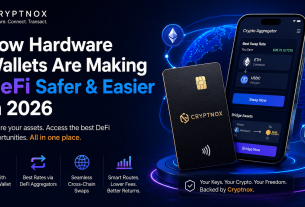
As Web3 adoption accelerates, users are increasingly seeking secure, convenient ways to manage and spend their digital assets. Traditional crypto wallets and exchanges offer functionality, but they often fall short in usability, portability, and real-world payment integration. This is where self-custodial wallet cards are changing the game.
In this blog, we’ll explore the evolution of Web3 hardware wallets, compare crypto smartcards vs EMV cards, and understand how modern hardware wallet cards are redefining crypto payments.
What is a Self-Custodial Wallet Card?
A self-custodial wallet card is a physical card that allows users to securely store, manage, and transact cryptocurrencies without relying on third-party custodians.
Unlike centralized exchanges, where your assets are controlled by a platform, self-custodial solutions ensure:
- You control your private keys
- You own your funds entirely
- You can transact directly on-chain
These cards combine the power of a Web3 hardware wallet with the convenience of a payment card.
Understanding Crypto Smartcards
A crypto smartcard is an advanced form of a hardware wallet embedded into a card format. It integrates secure chip technology to safely store private keys and execute cryptographic operations.
Key Features of Crypto Smartcards:
- Built-in secure element for private key storage
- Offline signing of transactions
- NFC or tap-to-use functionality
- Multi-chain support (Ethereum, Bitcoin, etc.)
- Integration with Web3 apps and wallets
Many modern solutions also combine FIDO2 smartcard capabilities, allowing:
- Passwordless authentication
- Secure login to Web3 platforms
- Protection against phishing attacks
This makes crypto smartcards not just a storage tool—but a complete identity and transaction solution.
What is an EMV Crypto Card?
An EMV crypto card refers to a crypto-linked debit or payment card that operates on traditional EMV (Europay, Mastercard, Visa) standards.
These are commonly known as crypto debit cards and are offered by exchanges or fintech companies.
Key Features of EMV Crypto Cards:
- Linked to a custodial crypto account
- Converts crypto to fiat at the time of payment
- Works at POS terminals worldwide
- Supports ATM withdrawals
While convenient, these cards typically:
- Do not give full control over private keys
- Require KYC and platform dependency
- Operate within traditional banking rails
Crypto Smartcards vs EMV Cards: Key Differences
| Feature | Crypto Smartcard (Hardware Wallet Card) | EMV Crypto Card (Crypto Debit Card) |
| Custody | Self-custodial (you own keys) | Custodial (platform owns keys) |
| Security | High (offline key storage) | Moderate (platform-based) |
| Transactions | On-chain signing | Fiat conversion |
| Privacy | High | Low (KYC required) |
| Usage | Web3 + payments | Traditional payments |
| Authentication | FIDO2 smartcard support | Standard PIN-based |
Why Self-Custodial Wallet Cards Are the Future
The rise of hardware wallet cards reflects a shift toward user sovereignty in finance. Here’s why they’re gaining traction:
1. True Ownership
With a self-custodial wallet card, users are no longer dependent on exchanges. You hold your private keys—meaning full control over your assets.
2. Enhanced Security
Unlike hot wallets or exchange accounts, crypto smartcards store keys in secure elements, making them resistant to hacks and malware.
3. Seamless Web3 Integration
These cards act as a bridge between physical and digital finance, enabling:
- DeFi participation
- NFT transactions
- On-chain payments
4. Multi-Functionality
Modern cards combine:
- Web3 hardware wallet
- Crypto debit card functionality
- FIDO2 smartcard authentication
This all-in-one approach simplifies the user experience.
Use Cases of Crypto Smartcards
Crypto smartcards are not just for storing assets—they unlock multiple real-world applications:
- Secure Payments: Tap and pay using crypto
- DeFi Access: Interact with decentralized apps
- Identity Verification: Use FIDO2 authentication for secure login
- Travel-Friendly Wallet: Carry crypto securely without bulky devices
- Business Transactions: Enable secure B2B crypto payments
Limitations of EMV Crypto Cards
While EMV crypto cards are widely used, they come with certain limitations:
- Dependence on centralized platforms
- Exposure to account freezes or restrictions
- Hidden fees in crypto-to-fiat conversion
- Limited Web3 functionality
They are ideal for spending but not for true ownership or advanced crypto use cases.
The Hybrid Future: Best of Both Worlds
The next generation of self-custodial wallet cards is combining the strengths of both systems:
- Self-custody for asset control
- Payment rails for real-world usability
- Authentication layers for security
This hybrid model is shaping the future of digital finance—where users don’t have to choose between convenience and control.
Final Thoughts
The debate between crypto smartcards vs EMV cards ultimately comes down to one key factor: control vs convenience.
- If you prioritize ease of spending, an EMV crypto card may suffice.
- If you value security, ownership, and Web3 integration, a self-custodial wallet card is the better choice.
As the crypto ecosystem matures, solutions that combine Web3 hardware wallet, crypto debit card, and FIDO2 smartcard capabilities will lead the market.